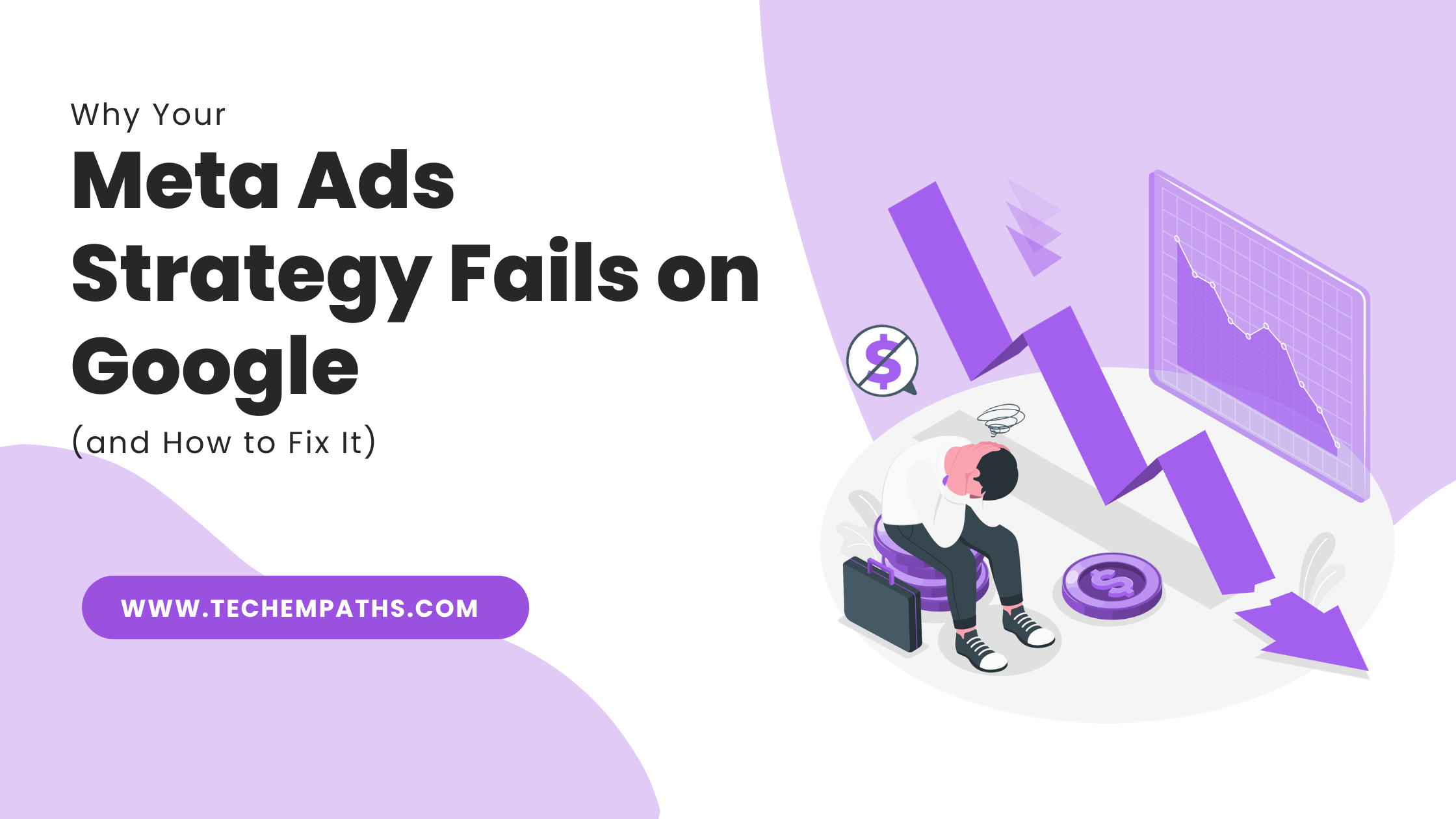

For the modern e-commerce founder, Meta is often the “cradle” of the brand. It’s where you found your first customers through thumb-stopping video and surgical interest targeting. Your creative team is a well-oiled machine, and your ROAS (Return on Ad Spend) is predictable.
But then comes the directive: “We need to diversify.” Naturally, you look to Google Ads. It is the largest advertising engine on the planet, capturing trillions of intent signals every day. However, many brands treat Google like “Meta with Keywords.” They port over the same imagery, the same budget logic, and the same expectations.
The result? A “express ticket” to a very expensive, very frustrating conversation with leadership. In 2026, the gap between social and search has only grown wider. To succeed, you don’t just need a new account; you need a DNA shift.
1. The Trap of “Synthetic Growth” (Retention vs. Acquisition)
The most common mistake for Meta natives is a misunderstanding of Performance Max (PMax). Because PMax uses automation to find conversions across YouTube, Gmail, Search, and Display, it often defaults to the path of least resistance.
The Illusion of Success
If you launch PMax without strict “New Customer Acquisition” goals, the algorithm will follow your past customers around the internet. It will show ads to people who were already searching for your brand name or who already have your product in their cart.
- The Symptom: Your dashboard shows a 6.0x ROAS, but your total Shopify revenue isn’t moving.
- The Reality: You are paying Google a “commission” on sales you would have made for free.
The Strategy Shift: You must implement Customer Match lists immediately. Upload your existing customer data and tell Google: “Do not bid on these people.” This forces the AI to venture into “cold” territory, finding people who have never heard of you but are actively searching for your solution.
2. The Psychology of the Click: Interruption vs. Intent
On Meta, you are a party crasher. People are there to see photos of their friends; your ad has to be interesting enough to interrupt that experience. On Google, you are a concierge. People are asking a specific question, and they expect a specific answer.
Understanding the “Intent Spectrum”
- Low Intent: “Best summer outfits 2026” (Informational)
- High Intent: “Waterproof polarized floating sunglasses for fishing” (Transactional)
If you use the same landing page for both, you will bleed money. Meta experts often send all traffic to a flashy, high-production “collection” page. On Google, if a user searches for a specific product, they should land on that specific product page—or better yet, a dedicated Advertorial.
The “Pre-Sell” Secret: Because Google users are “hunting,” they are more skeptical. A long-form landing page (the “Advertorial” style) that explains why your product solves their specific search query will almost always outperform a standard product page.
3. Feeding the Machine: The Product Feed is Your New “Creative”
On Meta, your video editor is your MVP. On Google (specifically for Shopping and PMax), your Feed Manager is the MVP.
Why the Feed Matters
Google doesn’t “watch” your videos to decide who to show them to; it “reads” your data. If your product title is just “The Apex Jacket,” Google has no idea who needs it.
- Bad Title: The Apex Jacket – Blue
- Optimized Title: Apex Men’s Waterproof Gore-Tex Ski Jacket – Blue – Breathable Winter Coat
By optimizing your Google Merchant Center feed with rich attributes (material, size, color, age group), you are essentially “SEO-ing” your ads. This is the single most under-utilized lever in e-commerce today.
4. The “Learning Phase” Limbo and Budget Fragility
Google’s Smart Bidding is an incredibly powerful AI, but it is a “data-hungry” beast. It requires a specific volume of conversions—usually 30 to 50 in a 30-day window—to move out of “Learning Mode.”
The “Drip-Feed” Failure
Small brands often try to “test the waters” with a tiny budget spread across 20 different campaigns. This is a death sentence on Google. Each campaign ends up with 2 or 3 conversions a month. The AI never learns, the CPAs (Cost Per Acquisition) stay high, and the brand eventually quits, claiming “Google doesn’t work for us.”
The Consolidation Framework: Instead of 10 campaigns with $20/day, run one “Power Campaign” with $200/day. Give the algorithm the “fuel” it needs to find a pattern. Once it finds the winning pattern, you can then begin to segment.
5. Efficiency Guardrails: The tROAS Strategy
When moving from Meta, you might be used to “Cost Caps.” On Google, the equivalent is Target ROAS (tROAS). If you leave your campaign on “Maximize Conversion Value,” Google is like a shopper with your credit card and no budget: it will buy everything it sees. By setting a Target ROAS, you are telling Google: “You can spend this money, but only if you can maintain a 300% return.”
The “Aggression” Balance
A common mistake is setting your tROAS too high too early. If your break-even is 200% and you set a 500% target on day one, the campaign will likely stop spending entirely. Start with a “realistic” target based on your Meta performance, then slowly “tighten the screws” by 10% every two weeks as the data stabilizes.
6. Infrastructure & Operational Integrity
In the world of Search, a “glitch” is a catastrophe. On Meta, if your pixel drops for an hour, the algorithm usually recovers quickly. On Google, if your Merchant Center gets a “404 error” because of a site update, your entire Shopping presence can be wiped out in minutes.
The “Account Health” Checklist
- Enhanced Conversions: Ensure you are passing hashed first-party data back to Google to combat the loss of cookies in 2026.
- Negative Keyword Lists: Unlike Meta, you need to tell Google where not to show up. If you sell luxury watches, you need to exclude terms like “cheap,” “free,” “replica,” and “battery replacement.”
- Redundancy: Ensure your payment methods are backed up. A failed billing cycle on a Friday night can lead to a “re-learning” period that lasts all the way through Tuesday.
Conclusion: Fighting on Two Fronts
Diversifying into Google Ads is the “graduation” phase of an e-commerce brand. It protects you from the volatility of a single algorithm and allows you to capture customers at the exact moment they are looking for a solution.
However, success requires humility. You have to be willing to be a “beginner” again. Stop looking for the “Meta equivalent” of every feature and start embracing the logic of Intent. When you combine the Desire created on Social with the Demand captured on Search, you don’t just have a marketing strategy—you have a market-dominating engine.


Leave a Reply